
Fire Alarm Cables in High Demand for New Construction Builds
- Kassie Teagarden
- Wire & Cable
- May 17, 2023
- 3169views

Fire Alarm Cables in High Demand for New Construction Builds
Written By: Kassie Teagarden, Senior Content Marketing Specialist, LAPP Tannehill
The demand for new construction buildings is higher than ever – requiring a hard look at how cabling installation techs choose the right fire alarm cable.
If you’re in new build construction, then it’s likely you’ll need licensed professionals to install necessary things in the building – including fire alarm cables.
So, whether you’re a site foreman, project manager, general manager, electrician, network cabling technician, purchasing officer, commodity manager, procurement buyer, cabling contractor, or cable installation tech – you're probably on the search for fire alarm cables needed for the residential or commercial property.
How to choose the right fire alarm cable
Although it may not be the most complex decision to make, fire alarm cables are a crucial aspect of building safety that should not be overlooked. First, let's start with the basics.
Fire alarm cables are an essential component of any fire alarm system. They are responsible for transmitting signals from the fire alarm control panel to the various devices throughout the building, such as smoke detectors, heat detectors, and sprinkler systems.
Plenum & Non-Plenum
Having reliable fire alarm cables allows for quick and accurate detection of fires so when it comes to new construction builds, it's important to choose the right type of fire alarm cable. There are two main types: plenum and non-plenum.
Plenum cables are designed for use in areas with air handling systems, such as ducts and ceilings. They are made with special materials that are fire-resistant and emit less smoke and toxic fumes in the event of a fire.
Non-plenum cables, on the other hand, are suitable for use in areas without air handling systems.
FPLR & FPLP
FPLR stands for Fire Power Limited Riser, which is the minimum rating required for fire alarm cables in most buildings. This rating means that the cable can withstand fire for up to two hours and is suitable for use in vertical risers.
FPLP stands for Fire Power Limited Plenum. This rating is required for cables that are installed in plenum spaces, which are areas in a building where air circulates, such as above suspended ceilings. The FPLP rating means that the cable can withstand fire for up to two hours and is designed to prevent the spread of smoke and toxic fumes.
Risk & Safety Standards
You'll need to choose cables that are appropriate for your specific application. This may include factors such as the size of the building, the type of fire safety system being used, and the level of risk associated with the building.
You'll need to make sure your cables are compliant with relevant safety standards. In the U.S., fire alarm cables must meet the requirements of the National Fire Protection Association (NFPA) and Underwriters Laboratories (UL). These standards ensure that the cables are safe and reliable, and that they meet the necessary performance requirements.
Size & Length
It's also important to consider the size and length of the cables. The size of the cable will depend on the size of the building and the number of devices that need to be connected.
The length of the cable will depend on the distance between the devices and the control panel. It's important to ensure that the cables are long enough to reach all the necessary devices without any excess length that could cause any hazards.
Shielded & Non-Shielded
Another feature of fire alarm cables to consider is their ability to resist electrical interference. Fire alarm cables are often shielded to protect against electromagnetic interference, which can cause false alarms or even prevent the system from detecting a fire.
Check out our shielded fire alarm cables and our unshielded fire alarm cables.
Power Limited & Non-Power Limited
Power limited cables are cables that are designed to carry low-voltage electrical currents and are typically used for low-power applications such as security systems, intercoms, and fire alarms.
Non-power limited cables, on the other hand, are designed to carry high-voltage electrical currents and are used for higher-power applications such as lighting and HVAC systems.
Power limited cables are designed to handle low-voltage currents, typically 30 volts or less. Non-power limited cables, on the other hand, can handle much higher voltages, typically up to 600 volts.
Another key difference between the two types of cables is the level of insulation required. Power limited cables require less insulation than non-power limited cables, as they carry lower voltages. This means that power limited cables are often smaller and more flexible than non-power limited cables, making them easier to install in tight spaces.
Fire Alarm Cables for New Construction Apartments on the Rise
If you’re noticing more apartment buildings being built in your neighborhood, you’re not imagining it – Over 971,000 apartment units were being built in the US by the end of 2022, the second-highest number ever recorded.
According to research commissioned by the National Multifamily Housing Council and National Apartment Association, the U.S. needs 4.3 million new apartment units by 2035 to address apartment demand and the shrinking supply of affordable housing.
Texas, Florida, and California will account for 40% of future demand for apartments. The report estimates that these states will require 1.5 million new apartments by 2023.

Image source: Grecu, V. (2022). Top 20 U.S. Metros by Projected New Apartments [Datawrapper image]. Rent Café. https://www.rentcafe.com/blog/rental-market/market-snapshots/apartment-construction-2022/
This construction boom is fueled by pent-up demand for apartments across the country, particularly as some renters delay their homeownership aspirations due to high inflation and increasing interest rates.
The projected increase in demand for apartments consequently requires more fire alarm cable installations in those buildings.
Fire Alarm Cables at LAPP Tannehill
As a well-trusted wire, cable, and connectivity distributor, LAPP Tannehill has access to over 200 leading manufacturers allowing our customers to find the right product for their use case. Let us help you find what you’re looking for when it comes to your fire alarm cable needs.
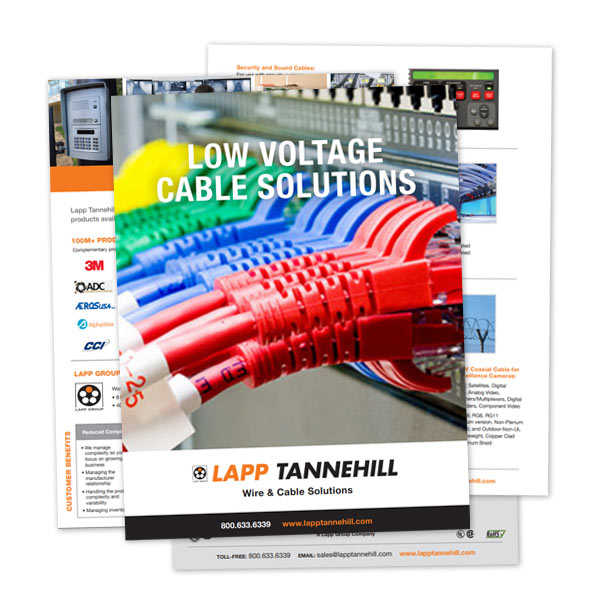
LAPP Tannehill offers fire alarm cables for use in fire monitoring/detection, power-limited fire alarm systems, smoke detectors, audio circuits, signaling, fire protective circuits, control circuits, and security systems.
- FPLR Riser Rated-CL2R/CMR/CMG/FT4
- FPLP Plenum Rated-CL2P/CMP/FT6
- FPLR Data Grade-CL2R/CMR
- FPLP Data Grade-CL2P
- Non-Power Limited
- Dual-Shield and Quad Shield
- Copper Clad Steel center conductor, or Solid Bare Copper
See all available fire alarm cables here
Reach out to us if you have questions or call us at 800-633-6339 to talk to one of our representatives. Download our Low Voltage Cable Solutions brochure to learn about more applications.
Categories
Recent Posts





 RSS Feed