
Cable Failure is Not an Option: Invest in Next-Level Cable Protection
-
 LAPP Tannehill
 - Tubing & Sleeving
- Dec 23, 2025
- 369views
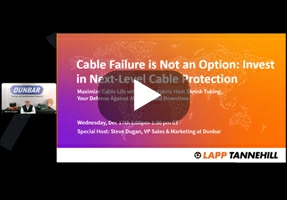
Cable Failure is Not an Option: Invest in Next-Level Cable Protection
In the world of industrial engineering, we often treat cables as 'set it and forget it' components. We spec them based on idealized, theoretical conditions, ensuring the jacket material meets the basic requirements of the datasheet.
But as any maintenance manager or field engineer will tell you, the factory floor is rarely as forgiving as a controlled environment.
In a recent webinar featuring Steve Dugan, VP of Marketing & Sales at Dunbar, the conversation centered on a harsh reality: even the most robust cables are failing prematurely. The culprit isn’t usually a catastrophic event, but rather the slow, silent "death by a thousand rubs."
Watch the webinar: https://7222464.hs-sites.com/cable-failure-is-not-an-option-webinar
The Hidden Stressors of the "Real World"
LAPP Tannehill opened the discussion with a poignant observation: "Once a cable is actually in service, the real conditions often reveal weaknesses the design phase didn’t anticipate."
According to Dugan, four main culprits consistently bypass theoretical specs to destroy cable integrity:
- 1. Constant Abrasion: Continuous rubbing against equipment or other cables.
- 2. High Stress Points: Sharp brackets or tight-routing paths.
- 3. Sharp Edges: Micro-cuts that compromise the jacket over time.
- 4. High-Cycle Vibration: The "death rattle" found in utilities boom trucks and robotic arms.
"The jacket is the sacrificial layer," Dugan explains. "Its entire purpose is to shield the delicate inner components—the insulation and the shielding—which are absolutely critical for signal integrity. The problem is that most standard jackets are not designed for the constant, aggressive friction we see in heavy-duty environments."
The True Cost of Failure: A $50,000 Lesson
When a jacket fails, the costs aren't measured in the price of a few feet of cable. They are measured in downtime.
Dugan shared a story from his family farm involving a high-horsepower tractor. A simple sensor cable—a component worth perhaps $50—suffered a jacket failure due to a hydraulic line wearing thin. The result? The transmission shorted out. The total repair bill, including labor and parts, exceeded $50,000.
Whether it’s an agricultural tractor, a robotic welding cell, or a wind turbine, the math remains the same: Prevention is a fraction of the cost of a cure.
Introducing the "Bulletproof Vest" for Cables
If the standard plastic jacket is the first line of defense, Dugan suggests we need a second, tougher line. He refers to Woven Fabric Heat Shrink Tubing as the "bulletproof vest" of the cable world.
But what makes this material different from the standard heat shrink you find in a local hardware store?
The Science of the Weave
Unlike standard extruded plastic tubing, ArmorFlex® (Dunbar’s engineered solution) utilizes a precisely engineered woven structure of Polyester and Polyolefin.
- Load Distribution: Because it is interlaced, the fabric spreads impact and abrasion across multiple strands rather than allowing force to concentrate on a single point.
- A "Shrink-to-Fit" Armor: When heat is applied, it doesn’t just get smaller; it forms a tight, custom-fitted reinforcement that stays in place without slipping or bunching, even under continuous movement.
- Breathability: Unlike conduit or split loom, the open-weave design prevents moisture, humidity, and heat from being trapped, which drastically reduces the risk of corrosion and mold.
- Curiosity Gap: In the webinar demo, Steve demonstrates how easy it is to slide this armor over existing connectors. You’ll want to see the 2:1 shrink ratio in action—it’s the difference between a loose sleeve and a "locked-in" protective layer.
Industry Applications: Where "Operational Insurance" is Non-Negotiable
The webinar highlighted several key industries where standard cables simply cannot survive the lifecycle of the machine without extra help.
Transportation and Heavy Machinery
On trailers, cranes, and garbage trucks, cables are exposed to "cable-on-metal" abrasion and road debris. For a crane flexing hundreds of feet in the air, wind-induced vibration fatigue is a constant threat. ArmorFlex, aka WFHS-221, acts as a dampener, absorbing the vibration before it can stress the internal copper strands.
Energy and Infrastructure
In oil extraction and wind energy, the enemy is chemical. ArmorFlex is designed to resist:
- Hydraulic fluids and oils
- Brake fluid and battery acid
- Antifreeze and gasoline
- UV exposure from harsh outdoor environments
Marine and Power Generation
One of the most surprising benefits of the woven construction is its ability to eliminate rattle. In engines and generators, the snug fit reduces noise while the self-extinguishing properties (extinguishing within 60 seconds) provide a critical safety layer.
The "Cheaper Alternative" Trap
During the Q&A session, a participant asked a question every procurement manager has on their mind: "We already use standard heat shrink tubing, which is cheaper. Why switch?"
Dugan’s response was direct: Standard heat shrink is just a thicker plastic layer.
If you are bundling wires in a controlled cabinet, standard heat shrink is fine. But if your application involves movement, standard plastic will eventually wear through just like the cable jacket. ArmorFlex isn't just "thicker"; it’s a different mechanical structure.
"You’re not just buying premium heat shrink," Dugan noted. "You’re protecting the much more expensive assets your operation depends on."
Why You Should Watch the Full Demo
While we can describe the material science, there is no substitute for seeing the installation process. The webinar includes a technical demo that covers:
- The "Cold" Slide: How the material behaves before heat is applied (and why it’s a game-changer for retrofits).
- The Recovery Phase: A close-up look at how the polyester-polyolefin weave conforms to irregular shapes.
- The "Finished" Flexibility Test: Seeing how a fully armored cable maintains its range of motion without the "stiffness" of traditional conduit.
Conclusion: Don't Wait for the Short Circuit
Cable failure is often treated as an "accident," but in high-vibration, high-abrasion environments, it is an eventuality. By reinforcing your assemblies with woven fabric heat shrink, you aren't just adding a layer of plastic—you're adding a layer of operational insurance.
To reiterate our webinar closing –
Maximizing cable life is critical to your bottom line.
Ready to see the "Bulletproof Vest" in action? Watch the full Webinar On Demand here to see the live demo and hear the full deep-dive into the material science of ArmorFlex.
Related Posts







 RSS Feed